Elon Musk’s Visionary Plan: Revolutionizing Stock Trading with a Hub on X

Introduction

Renowned entrepreneur and innovator, Elon Musk, continues to make waves in the business world with his groundbreaking ideas. The latest report suggests that Musk has set his sights on transforming the stock trading landscape by creating a hub on X, promising to revolutionize how users trade stocks. In this article, we explore the potential implications of Musk’s ambitious plan and its possible impact on the financial industry.

The Concept of the Hub on X

The specifics of Elon Musk’s plan remain mostly shrouded in secrecy, but insiders have hinted at the creation of a centralized platform on X. This platform would purportedly offer users a simplified and seamless stock trading experience, harnessing cutting-edge technology to maximize efficiency and accessibility.

Key Features and Benefits

Musk’s hub on X aims to address various pain points currently associated with traditional stock trading. Some potential features and benefits could include:

  1. User-Friendly Interface: The platform is expected to have an intuitive and user-friendly interface, making it easier for both novice and seasoned traders to navigate the stock market.
  2. Real-Time Data: Access to real-time stock market data and advanced analytics may empower users to make informed investment decisions.
  3. Reduced Transaction Costs: By eliminating middlemen and streamlining processes, Musk’s hub could significantly reduce transaction costs, democratizing stock trading.
  4. Global Accessibility: Leveraging X’s global reach, the platform could potentially extend stock trading opportunities to regions with limited access to traditional financial markets.
  5. Enhanced Security: With Musk’s emphasis on cybersecurity in his other ventures, the hub on X is likely to prioritize robust security measures to safeguard users’ financial data.
  6. Integration with Cryptocurrencies: Given Musk’s fascination with cryptocurrencies, the platform might incorporate digital assets, introducing new avenues for investment.

Potential Challenges

While the concept of Musk’s hub on X is exciting, it may face some obstacles:

  1. Regulatory Hurdles: Financial markets are subject to stringent regulations, and establishing a global stock trading platform may require extensive legal compliance.
  2. Market Resistance: Traditional financial institutions and stock exchanges may perceive Musk’s initiative as a threat to their established dominance and resist its integration.
  3. Trust and Credibility: Building trust with users and the wider financial community will be crucial for the success of the hub on X.

Conclusion

Elon Musk’s ambition to create a hub on X for stock trading has the potential to disrupt the conventional financial industry. If successful, it could democratize access to stock markets, redefine user experience, and leverage technology to bring about a new era of stock trading. However, the road ahead will undoubtedly be filled with challenges that Musk and his team must navigate. As the visionary entrepreneur has shown in the past, his determination to push the boundaries of innovation may yet again reshape an entire industry. Only time will tell if his vision becomes a reality and the impact it will have on the world of stock trading.

Elon Musk plans to revolutionize stock trading by creating a hub on X, a platform that promises to simplify and enhance the trading experience. The hub aims to offer real-time data, reduced transaction costs, global accessibility, and heightened security, potentially integrating cryptocurrencies as well. Challenges include regulatory hurdles and market resistance. If successful, Musk’s vision could democratize stock market access and reshape the financial industry. The article emphasizes the potential impact of this ambitious initiative, acknowledging both its benefits and obstacles on the path to transforming stock trading.

One aspect worth mentioning is Elon Musk’s track record as an innovative entrepreneur. Throughout his career, he has demonstrated a knack for disrupting various industries, from electric vehicles with Tesla to space exploration with SpaceX. This history of pushing boundaries and challenging conventional norms adds further weight to the potential impact of his plan to create a hub on X for stock trading.

Moreover, the article could also touch upon the broader implications of such a platform. If successful, Musk’s hub on X might not only change how individuals trade stocks but also influence the overall dynamics of the financial industry. Traditional stock exchanges and financial institutions may need to adapt to the changing landscape and explore ways to remain competitive in the face of this disruptive force.

Additionally, it would be interesting to highlight the level of public interest and scrutiny that this venture could attract. Given Musk’s high-profile status and the global reach of his companies, any developments related to the hub on X would likely receive considerable attention from the media, investors, and regulatory bodies.

In conclusion, the article could emphasize that while Elon Musk’s plan to create a hub on X holds great promise for transforming stock trading, its realization will require navigating significant challenges. Nonetheless, the vision of democratizing access to financial markets and leveraging technology to enhance the trading experience is undeniably compelling, making this initiative one to watch closely in the evolving landscape of the financial world.


Speculation Surrounding Jared Kushner’s Alleged Cooperation: Analyzing the Missing Links in the Indictment

Introduction: In a recent revelation, former Trump fixer Michael Cohen has claimed that there might be evidence suggesting Jared Kushner’s cooperation with authorities. This comes amid a major indictment where names like Kushner and Mark Meadows were notably absent. Cohen’s statement has sparked speculation about Kushner’s potential involvement and whether he would flip on his father-in-law, former President Donald Trump, to protect himself. In this article, we delve into the claims made by Cohen, the significance of names missing from the indictment, and the complexities surrounding Kushner’s potential role.

The Indictment’s Missing Links: Cohen’s argument primarily revolves around the absence of certain names from the indictment. While six co-conspirators were mentioned, notable figures like Kushner and Meadows were conspicuously missing. According to legal experts, the omission of prominent names can indeed provide insights into ongoing investigations and potential cooperation agreements. However, it’s crucial to remember that the absence of a name in an indictment does not automatically indicate cooperation.

Jared Kushner’s Alleged Cooperation: Cohen’s suggestion that Kushner might be a cooperating witness remains speculative at this point. Without concrete evidence or official statements, it is premature to draw any conclusions about Kushner’s involvement in ongoing investigations. As the former secretary of everything during his father-in-law’s presidency, Kushner’s proximity to Trump raises questions about the extent of his knowledge and potential implications.

Motivations and Complexities: If Kushner were to cooperate with authorities, his motivations could be multifaceted. Personal self-preservation, adherence to the rule of law, or concerns about potential legal consequences might influence such a decision. However, loyalty to family and concerns about the impact on personal relationships can also play significant roles in such situations. Speculation on these matters should be approached with caution, recognizing that individuals’ actions can be influenced by a multitude of factors.

The Importance of Concrete Evidence: While speculation may pique public interest, it is essential to remember that legal matters demand factual evidence. The absence of a name in an indictment does not prove guilt, innocence, or cooperation. Investigative processes are intricate, and drawing definitive conclusions without verified information risks spreading misinformation.

Conclusion: The recent claims made by Michael Cohen regarding Jared Kushner’s potential cooperation have sparked public interest and speculation. However, as observers, it is essential to remain grounded in the principles of justice and due process. Without concrete evidence, any conclusions regarding Kushner’s alleged cooperation or motives remain speculative. Legal experts and authorities will diligently pursue their investigations, and until concrete information emerges, the situation surrounding Kushner’s involvement remains uncertain. As the story unfolds, the public must remain cautious, seeking verified sources and evidence-based reporting to gain a comprehensive understanding of the situation.

Trump’s Trial Shuffle: An Attempt to Flee Political Accountability?

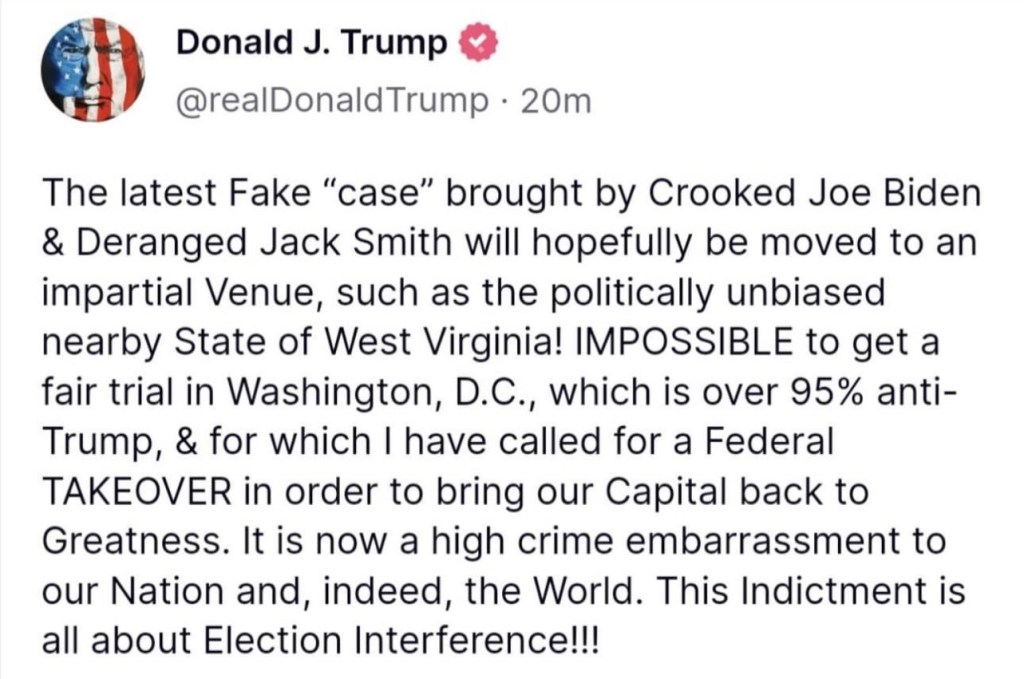
In a recent tweet, Jon Cooper highlighted former President Donald Trump’s alleged attempt to move his trial from Washington D.C. to the “politically unbiased nearby state of West Virginia.” The tweet humorously pointed out the geographical inaccuracy of West Virginia being a neighboring state to D.C. and raised questions about Trump’s motives in seeking such a relocation.

While the humor in the tweet may provoke laughter, the underlying issue at hand is far from a laughing matter. The attempted trial maneuver appears to be an effort by Trump to seek a more favorable venue for his legal proceedings, potentially raising concerns about the former President’s willingness to be held accountable for his actions.

Moving the trial to a different jurisdiction could have significant implications for the case. Washington D.C., as the nation’s capital, holds historical and political significance, serving as a symbol of the nation’s governance and justice system. A trial within the district carries a certain weight and responsibility in upholding the rule of law.

By attempting to shift the trial to West Virginia, Trump may be seeking a venue perceived to be more sympathetic to his cause. This move raises questions about the transparency and integrity of the justice system and may erode public confidence in the impartiality of the proceedings.

Moreover, the suggestion that West Virginia is a “politically unbiased” state is subjective and open to interpretation. All states, to varying degrees, have their own political leanings and affiliations. Labeling any state as completely devoid of political bias is an oversimplification of the complex political landscape in the United States.

As a writer, it is essential to acknowledge that the tweet is a commentary, and its accuracy should be verified through reliable sources before forming an opinion. Analyzing Trump’s motives and actions should be approached with objectivity and a commitment to fact-checking.

Additionally, the situation highlights the significance of the legal system in holding public figures accountable for their actions. The trial should be conducted in a fair and transparent manner, free from undue influence or attempts to manipulate the proceedings.

It is crucial to consider the implications of such actions for the broader public discourse and the precedent they may set for future cases involving high-profile individuals. The judiciary’s independence and integrity are fundamental to upholding the rule of law in any democratic society.

In conclusion, Jon Cooper’s tweet humorously pointed out a geographical inaccuracy in Trump’s alleged attempt to relocate his trial to West Virginia. While the tweet is lighthearted, it raises serious questions about the former President’s intentions and the potential implications of such a move. As writers, we must approach these matters with objectivity and delve into the deeper issues at play to foster a more informed public discussion.

Creating a Positive Life: How to Overcome Trauma Through Habits

  1. Cultivate Mindfulness: Practicing mindfulness is an essential habit for overcoming trauma. Mindfulness allows us to become more aware of our thoughts and emotions without judgment, creating a safe space to process past experiences. Techniques such as meditation, deep breathing exercises, or journaling can help us embrace the present moment and develop a healthier perspective on our traumas.
  2. Seek Support: Sharing our struggles with a trusted friend, family member, or professional can be immensely beneficial. Building a support network allows us to feel understood, validated, and less isolated in our journey towards healing. Opening up about our experiences can also release pent-up emotions and reduce the emotional burden of trauma.
  3. Embrace Physical Activity: Regular exercise is not only beneficial for our physical health but also plays a significant role in our mental well-being. Engaging in activities such as walking, yoga, or dancing releases endorphins, which act as natural mood boosters and stress-relievers. Regular physical activity can help us channel our negative emotions into a positive outlet, promoting healing from trauma.
  4. Practice Gratitude: Cultivating a habit of gratitude can help shift our focus from dwelling on the negative aspects of our past to appreciating the positive aspects of our present. Each day, take a moment to identify and acknowledge the things you are grateful for, no matter how small they may seem. Gratitude can foster a positive mindset, making it easier to overcome the lingering effects of trauma.
  5. Establish a Routine: Creating a daily routine can provide structure and stability during the healing process. A well-structured routine allows us to set achievable goals, stay organized, and build positive habits gradually. Consistency is key to overcoming trauma, and a routine can support this journey by promoting a sense of accomplishment and progress.
  6. Engage in Creative Outlets: Expressing ourselves creatively can be therapeutic and cathartic. Whether through writing, painting, music, or any other form of art, creative outlets enable us to externalize our emotions and experiences. This process allows us to process trauma in a more constructive manner, promoting healing and growth.
  7. Prioritize Self-Care: Self-care is crucial for maintaining mental and emotional well-being. Make time for activities that bring you joy, relaxation, and peace. This could include reading a book, taking a soothing bath, spending time in nature, or engaging in a hobby. Prioritizing self-care nurtures a positive and compassionate relationship with ourselves, aiding in our journey to overcome trauma.
  8. Conclusion: Overcoming trauma through positive habits is a transformative journey that requires patience and dedication. By incorporating mindfulness, seeking support, embracing physical activity, practicing gratitude, establishing routines, engaging in creative outlets, and prioritizing self-care, we can gradually heal and create a positive life. Remember that healing is a unique process for everyone, and it’s essential to be gentle with yourself as you embark on this transformative path of growth and recovery.
Creating a Positive Life: How to Overcome Trauma Through Habits

Families are made in the heart

There is no such thing as a “broken family.” Family is family, and is not determined by marriage certificates, divorce papers, and adoption documents…

Families are made in the heart

In a world where legal documents and societal norms often define the structure of a family, it is crucial to recognize that the true essence of family lies in the bonds that form in the heart. Families are not merely determined by marriage certificates, divorce papers, or adoption documents, but rather, they are born out of love, care, and mutual support. This article delves into the concept that families are made in the heart, highlighting their resilience and the power of unconditional love that transcends any legal definition.

Family Beyond Legal Labels: The idea of a “broken family” is misleading and potentially harmful. It implies that a family loses its value or ceases to exist when faced with life’s challenges. However, the truth is that families evolve, adapt, and endure, proving their resilience in the face of hardships. The love shared within a family is not easily shattered by external circumstances but instead strengthens through adversity.

Families by Choice: One aspect often overlooked is the concept of “chosen family.” These are the people we hold dear and consider as family, despite not sharing blood ties or legal relations. Chosen families may comprise close friends, mentors, or even colleagues who have become integral parts of our lives. These relationships are equally valid and significant, demonstrating that family is a fluid and dynamic concept.

Parental Love and Adoption: Adoption is a beautiful testament to the idea that family is not limited by blood. Adoptive parents often choose to love and nurture children who may not be biologically theirs, illustrating the depth of love and commitment that can exist within a family. Love transcends genetics, and the bond formed between adoptive parents and their children can be just as strong, if not stronger, than biological ties.

Divorce and Resilience: The notion that divorce implies a “broken family” disregards the emotional resilience that individuals and families exhibit during challenging times. While divorce signifies the end of a marital relationship, it does not diminish the bond between parents and their children. Many separated parents successfully co-parent, putting their children’s well-being first and maintaining strong family connections.

Blended Families: Blended families, formed when individuals with children from previous relationships come together, are an example of the ever-evolving nature of family. Despite not having a biological connection, these families create loving environments where children can grow and flourish, showcasing the boundless capacity of love to bridge the gap between unrelated individuals.

Conclusion: Family is a force that transcends the constraints of legal documentation and societal norms. It is a bond formed by love, care, and support, enduring through life’s trials and triumphs. The notion of a “broken family” undermines the strength and resilience inherent in familial relationships. As we embrace the diversity of family structures and celebrate the love that binds them together, we come to realize that family is truly made in the heart, and its unyielding spirit is what makes it an eternal and cherished institution.

Donald Trump and the Shadow of Benedict Arnold”

In his recent tweet, Jon Cooper makes a bold statement, predicting that Donald Trump will be remembered as a worse traitor than Benedict Arnold in the annals of history. As a writer, it is essential to delve deeper into the context and significance of this comparison.

Benedict Arnold, a former American Revolutionary War general, is synonymous with betrayal. He infamously defected to the British side during the war, becoming one of the most reviled figures in American history. His act of treason stained his legacy forever, earning him a place in the historical pantheon of traitors.

Drawing parallels between Benedict Arnold and Donald Trump is a contentious and polarizing stance. While Donald Trump served as the 45th President of the United States, his presidency was marked by controversy, divisiveness, and unprecedented actions that left a significant impact on the nation.

To properly assess Cooper’s claim, it is crucial to consider Trump’s actions during his tenure. His policies and rhetoric ignited passionate responses from both supporters and critics, leading to heated debates over issues such as immigration, international relations, and domestic affairs.

The infamous January 6, 2021, Capitol insurrection further intensified the scrutiny of Trump’s actions. Critics argue that his refusal to concede the election and his rhetoric played a role in inciting the violence that unfolded that day, undermining the democratic process and the peaceful transfer of power.

However, defenders of Trump argue that labeling him a “traitor” is an unfair characterization. They maintain that his policies, including tax cuts and deregulation, positively impacted the economy and helped create jobs. Moreover, they assert that his “America First” approach was a response to a perceived neglect of domestic interests in previous administrations.

Additionally, it would be prudent to examine how public opinion, historical interpretation, and the broader political landscape influence the way individuals and events are remembered in history. Only through a comprehensive analysis can we gain a more nuanced understanding of the comparisons and implications of Cooper’s tweet.

In conclusion, Jon Cooper’s tweet offers a provocative comparison, sparking discussions about the legacies of Benedict Arnold and Donald Trump. As a writer, it is crucial to approach this topic with sensitivity and thorough research to present a comprehensive analysis of the historical and political nuances at play.

Promising Breakthrough: AOH1996 – The Miracle Molecule in the Fight Against Cancer

Introduction

In a groundbreaking discovery, researchers have unveiled a revolutionary “cancer killing” drug that contains the formidable molecule AOH1996. This momentous breakthrough has demonstrated its remarkable potential in annihilating all solid tumors during preclinical research, while preserving the well-being of healthy cells. The emergence of AOH1996 brings new hope and optimism to the oncology landscape, opening a path towards more effective and targeted cancer treatments.

The Miraculous Molecule: AOH1996

AOH1996, the cornerstone of this novel drug, is a remarkable molecule that exhibits unprecedented anticancer properties. Scientists have meticulously engineered the compound, enabling it to specifically seek out and target malignant cells, leaving healthy cells completely unharmed. This remarkable feature marks a significant step forward in the quest for safer and more effective cancer therapies.

Preclinical Research Results: A Ray of Hope

During preclinical studies, the results have been nothing short of astonishing. The AOH1996-infused drug exhibited exceptional efficacy in neutralizing solid tumors across various types of cancer. The targeted mechanism of action ensures that cancer cells are selectively destroyed, while surrounding healthy tissues remain unaffected, mitigating the often severe side effects seen in traditional chemotherapy and radiation treatments.

Understanding the Mechanism of Action

The success of AOH1996 lies in its ability to disrupt the survival pathways of cancer cells. By specifically targeting crucial molecular signals within malignant growths, AOH1996 causes cancer cells to undergo programmed cell death, known as apoptosis. This focused approach allows for the eradication of tumors without harming healthy tissue, an essential factor in improving the quality of life for cancer patients.

Road to Clinical Trials

The successful preclinical research marks a significant milestone in the drug development process. However, before AOH1996 becomes widely available to patients, it must undergo rigorous testing and evaluation in clinical trials. These trials will further investigate the molecule’s safety, efficacy, and optimal dosing in human subjects. While researchers are optimistic about its potential, it is crucial to remember that there is still a road ahead before its availability for widespread medical use.

Potential Impact on Cancer Treatment

Should the clinical trials yield positive results, AOH1996 could usher in a new era of cancer treatment. Its ability to target and eliminate solid tumors without causing harm to healthy cells could revolutionize how cancer is managed. Patients may experience reduced side effects, shorter recovery times, and improved outcomes, providing them with newfound hope in their battle against this relentless disease.

Challenges and Ethical Considerations

As with any scientific advancement, there are challenges and ethical considerations that need to be addressed. The potential cost of the drug, equitable access for patients worldwide, and potential long-term side effects are among the critical factors requiring careful evaluation as AOH1996 progresses through clinical development.

Conclusion

The discovery of AOH1996 and its impressive performance in preclinical research has ignited optimism among scientists, patients, and healthcare professionals alike. As the drug embarks on its journey through clinical trials, the possibility of a more effective, targeted, and gentler approach to cancer treatment becomes ever closer. The world watches with bated breath, hoping that this miraculous molecule will finally be the key to unlocking a future where cancer is no longer a dreaded adversary, but a conquered foe.

How to Greet People in Different Countries

Originally posted on SUITCASE Travel Blog: Traveling is a fascinating way to discover cultures, traditions, folklore, and customs from around the …

How to Greet People in Different Countries

Traveling is a fascinating way to discover cultures and traditions worldwide. Proper greetings play a vital role in creating positive interactions and avoiding embarrassing situations. Handshakes are widely used for greetings in many countries, symbolizing trust and friendship. In Europe, handshakes should be firm with good posture and eye contact, but in the Middle East, a firm grip is considered rude.

In New Zealand, the “hongi” is a traditional greeting where people press their noses and foreheads together. Tibetans greet each other by sticking out their tongues as a sign of not being possessed by demons. In Zimbabwe, people clap after a handshake, while in northern Mozambique, they applaud three times before saying “Hello.” Malaysians greet each other by gently taking hands and bringing them to the heart with a nod.

In Arab countries like Saudi Arabia, Iraq, and Turkey, greetings include handshakes, hugs, and kisses on both cheeks. In Thailand, the “wai” involves placing palms together at chest level or on the forehead with a slight bow. Japan’s traditional greeting is a bow, while in India and Nepal, people press their palms together and bow slightly.

In Greenland, family members and close people use the “kunik,” pressing noses and breathing on each other’s face. Apart from handshakes, kisses are also common greetings in countries like France, Spain, and Italy. The number of kisses may vary depending on the region.

Nigeria, a diverse African nation, has its unique greetings. A common greeting is a handshake with a smile, but it can vary based on cultural background. In Yoruba culture, a common greeting involves bending the knees slightly while shaking hands. In Hausa culture, men may place their right hand on their chest as a sign of respect when greeting elders.

Other countries not mentioned in the original article may have their distinctive greetings, such as bowing in South Korea and a nod or slight bow in the United Kingdom.

Learning and respecting local greetings and customs can enhance the travel experience and foster meaningful connections with people from different cultures. Each country’s unique way of greeting reflects its history, values, and beliefs, making the journey even more enriching and inspiring.

mitchteemley.com/2023/04/26/the-proper-way-to-greet-people-in-different-countries-traveling-tips-for-your-next-trip/

How to greet people in other countries

Design a site like this with WordPress.com
Get started